New Westcott-University Neighborhood Historic District
Residents can now apply for tax credits under the New York State Historic Homeownership Rehabilitation Tax Credit Program
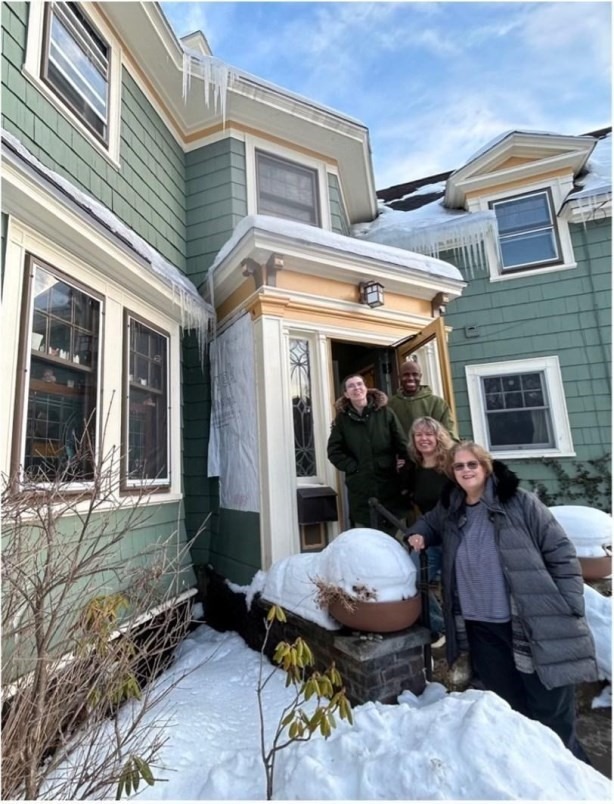
Two sets of neighbors who have applied for the tax credit include the folks in this photo, taken over Winter 2025/2026. From right, that’s Diane Murphy, Galyn Murphy-Stanley, former WNA Co-President, Galyn’s husband George Stanley, and Galyn’s sister Shannon Murphy.
Galyn has already applied for three tax credit applications involving three projects on two houses:
- First, the Murphy-Stanleys installed three mini-splits running off a single compressor, making AC available in portions of a duct-less house heated via cast iron radiators.
- Next, Diane needed a new roof with a full tear-off — on her brick two-family cottage down the block, where she lives with Shannon.
- Lastly, the Murphy-Stanleys opened up a can of worms hiding behind some failing plaster in that unique entry foyer. Decades of precipitation had caused the left-side wall to fail — requiring a new base, framing, shake siding, and a historically acceptable replacement window, still on order.
WNA has sampled the first year of applications from owner-occupants for New York State’s subsidy for qualifying repairs within the neighborhood’s new Westcott-University Historic District.
Though it may not yet be widely understood, the program offers a significant 20% giveback on future NYS income tax filings. Projects must be pre-approved and cost at least $5,000.
Here’s a short link to the application page: https://bit.ly/ny-rehab-tax-credit
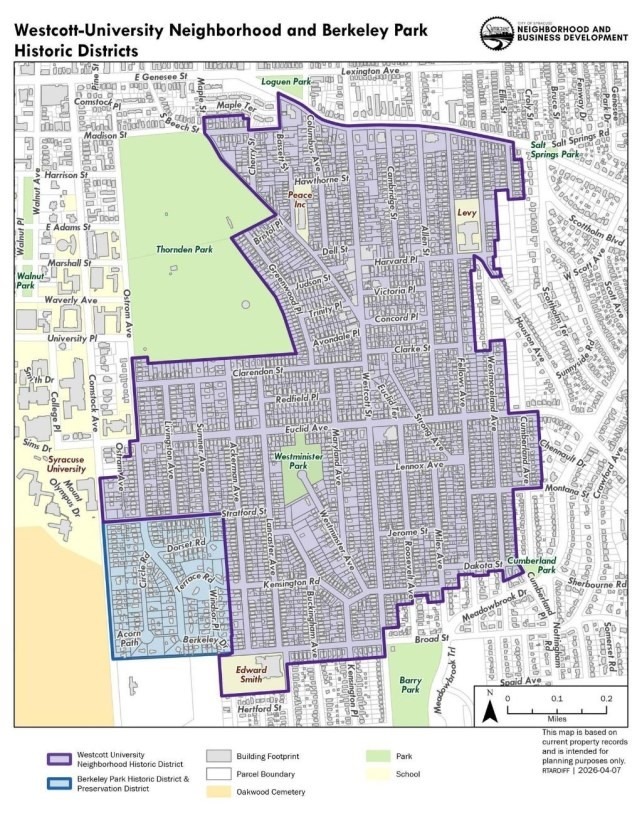
We think it’s an important matter of neighborhood self-preservation — to get the word out widely among those residents facing the challenge of renovations, improvements, or even just basic maintenance on historic district residences. That generally means all houses inside the lines on the map which were built prior to America’s Great Depression, or its eventual lifting through World War II.
For owner-occupants in such houses within the new district (or within the nearby, previously established Berkeley Park or Scottholm districts), here’s an example:
You may be thinking about organizing $25,000 in repairs or improvements — and $20,000 of that fits within the fairly flexible roster of project types which qualify with the State Historic Preservation Office (SHPO). If so, then submitting an application beforehand can lead to 20%, or $4,000 back, after completion, (on your next annual New York State Tax return)
Those not owing that much over a single year in state income taxes can roll over any remainder into future tax years. (This represents a change since January 2025, as, previously, any surplus credit was refundable by check, a feature which could potentially be returned through currently proposed legislation.)
After 2025 ended, Samuel D. Gruber of the Westcott Neighborhood Association (WNA) dug out some key info from New York State, tallying those qualified historic district owner-occupants citywide who filled out the electronic paperwork necessary for getting lined up on the 20% giveback, after finishing the work.
In the newly established Westcott-University district — the second largest statewide — 48 homeowners signed up, including a few early birds filing in late 2024.
All combined, these renovators forecast and described $1,317,862 in work which qualified for New York’s credit.
About half, or 24, managed to finish much of it within the same calendar year — sometimes reporting higher final expenses, and sometimes lower — setting themselves up to receive the certifications necessary for later getting 20% back.
Another note: Residential properties which happen to be in service as rentals also qualify under the historic district incentives, but the terms differ.
SHPO’s commercial category involves at least one important plus, and a big minus.
In-state landlords can get back not just 20%, but 50%, of the cost of pre-qualified repairs, combining both state and federal income tax credits.
However, they must commit to spend an amount matching or exceeding their adjusted cost basis. Needless to say, it’s well beyond our scope, but, for details, here’s a short link to the state’s relevant section for landlords: https://bit.ly/ny-landlord-rehab